Green Hydrogen: The Fuel of the Future, or an Expensive Distraction?
Hydrogen has been called the fuel of the future for so long that the phrase has become something of a punchline. For decades, hydrogen remained perpetually five to ten years away from commercialization. But in 2026, the hydrogen conversation has shifted from theoretical enthusiasm to practical reckoning — and the picture is more nuanced than either the evangelists or the skeptics would have you believe.
Hydrogen has been called the fuel of the future for so long that the phrase has become something of a punchline. For decades, hydrogen remained perpetually five to ten years away from commercialization. But in 2026, the hydrogen conversation has shifted from theoretical enthusiasm to practical reckoning — and the picture is more nuanced than either the evangelists or the skeptics would have you believe.
The key question is no longer "can hydrogen work?" but rather "where, when, and at what cost does hydrogen make sense compared to alternatives?" The answer depends heavily on one word: green.
The Color Spectrum of Hydrogen
Not all hydrogen is created equal. The hydrogen industry has developed a color-coding system to distinguish production methods by their carbon intensity:
Grey Hydrogen: The Status Quo
Grey hydrogen is produced through steam methane reforming (SMR) — reacting natural gas with high-temperature steam to extract hydrogen. This is how about 95% of hydrogen is produced today. It's cheap and well-established, but it releases significant CO₂ — roughly 9-10 kg of CO₂ per kilogram of hydrogen produced.
Blue Hydrogen: The Compromise
Blue hydrogen uses the same SMR process but adds carbon capture and storage (CCS) to trap the CO₂ before it enters the atmosphere. In theory, blue hydrogen can achieve 90-95% carbon capture. In practice, capture rates vary, and upstream methane leakage from natural gas production remains a concern. Blue hydrogen costs roughly $2-3 per kilogram — more expensive than grey but cheaper than green.
Green Hydrogen: The Gold Standard
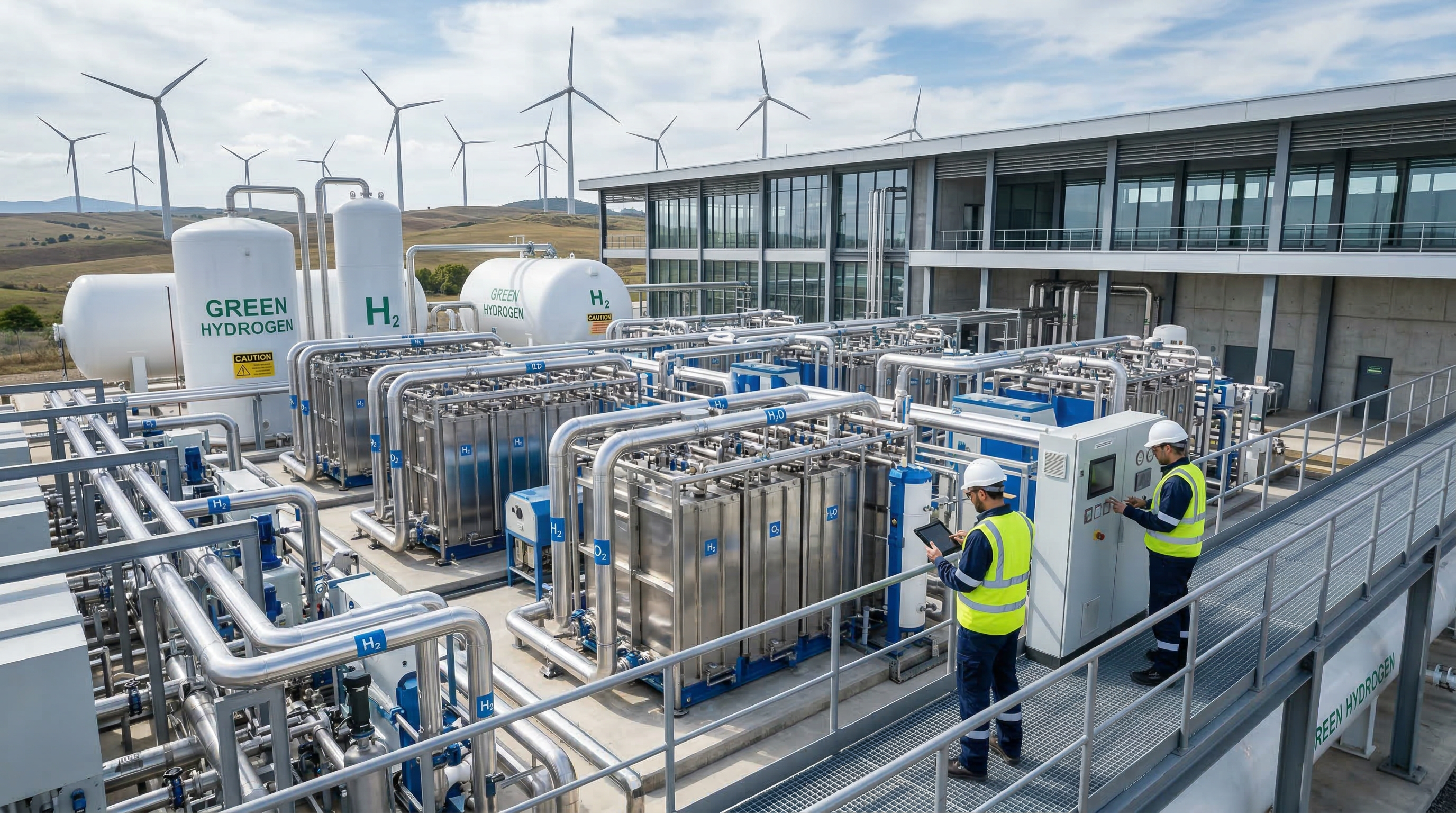
Green hydrogen is produced by splitting water into hydrogen and oxygen using electrolysis powered entirely by renewable electricity. The process is zero-emission if the electricity comes from wind, solar, or hydroelectric sources. This is the holy grail — genuinely clean hydrogen with no fossil fuel dependence and no carbon emissions. As solar panel efficiency continues to improve, the economics of green hydrogen production become increasingly favorable.
The problem is cost. Electrolysis requires significant electricity — roughly 50-55 kilowatt-hours to produce one kilogram of hydrogen. At typical renewable electricity costs of $0.03-0.05 per kWh, electricity alone represents $1.50-2.75 per kilogram. Add electrolyzer capital costs, maintenance, and balance-of-system components, and green hydrogen today costs $4-6 per kilogram — two to three times more expensive than grey hydrogen.
Other Colors: Turquoise, Pink, and More
The hydrogen rainbow continues. Turquoise hydrogen uses methane pyrolysis to produce hydrogen and solid carbon (rather than CO₂). Pink hydrogen uses nuclear power for electrolysis. Yellow hydrogen uses grid electricity. Each has proponents and trade-offs. For climate purposes, green hydrogen is the clear winner.
Where Green Hydrogen Makes Sense (and Where It Doesn't)
The decisive question is this: for any given application, is green hydrogen the best decarbonization solution, or are alternatives like direct electrification, batteries, or sustainable fuels more practical and cost-effective?
Passenger Vehicles: Battery EVs Won
The debate is effectively over for passenger cars. Battery-electric vehicles (BEVs) are cheaper, more efficient, and more convenient than hydrogen fuel cell vehicles (FCVs). Tesla, BYD, Volkswagen, and virtually every major automaker have committed to battery-electric platforms. Toyota, the longtime hydrogen champion with its Mirai FCV, has shifted resources toward battery EVs.
The efficiency gap is stark. Battery EVs convert about 70-80% of grid electricity into motion. Hydrogen vehicles lose energy at every step — electrolysis (~70% efficient), compression/storage (~90%), fuel cell conversion (~60%) — resulting in well-to-wheel efficiency around 25-35%. That's two to three times less efficient than batteries.
For cars, hydrogen has lost. But other applications tell a different story.
Heavy-Duty Trucking: The Open Question
Long-haul trucking is more contentious. Battery-electric trucks work well for regional routes under 300 miles, but long-haul routes covering 500+ miles per day face challenges with battery weight, charging time, and limited charging infrastructure.
Hydrogen fuel cell trucks offer 500-700 mile range and 10-15 minute refueling — closer to diesel operational patterns. Companies including Nikola, Hyzon, and Hyundai are deploying fuel cell trucks, particularly for heavy loads and long distances.
However, battery technology is improving rapidly. Solid-state batteries promise significantly higher energy density, potentially enabling battery trucks to cover long-haul routes economically. The verdict on trucking isn't final.
Maritime Shipping: A Strong Hydrogen Use Case
Ships are too large and operate too long between refueling for batteries to be practical for ocean-going vessels. Ammonia (made from green hydrogen) and methanol (which can also be hydrogen-derived) are emerging as leading zero-carbon fuel candidates for shipping.
Maersk, the world's largest container shipping company, has ordered methanol-powered vessels. Ammonia-powered ships are in development. The International Maritime Organization has set a target of net-zero emissions by 2050, and hydrogen-derived fuels are likely the only viable pathway.
Aviation: Hydrogen's Biggest Challenge
Aviation is hydrogen's most difficult application. Liquid hydrogen has roughly one-quarter the energy density of jet fuel by volume (though higher by weight), requiring larger fuel tanks and significant aircraft redesign. Cryogenic storage at -253°C adds complexity and weight.
Despite these challenges, ZeroAvia and Universal Hydrogen are developing hydrogen-electric propulsion for regional aircraft. Airbus has announced plans for a hydrogen-powered commercial aircraft by 2035. But sustainable aviation fuels (SAFs) — drop-in replacements for jet fuel made from biomass or captured CO₂ — face fewer technical barriers and may dominate long-haul aviation.
Steel and Cement: Where Hydrogen Truly Shines
Heavy industry is where hydrogen makes the strongest case. Producing steel and cement requires extreme heat — temperatures that electricity alone struggles to provide efficiently. Hydrogen can burn at high temperatures or serve as a chemical reducing agent.
Green steel production using hydrogen instead of coal-based blast furnaces is already being piloted. Sweden's SSAB, Germany's ThyssenKrupp, and ArcelorMittal are investing in hydrogen-based direct reduced iron (DRI) processes. Hydrogen can eliminate 95% of steelmaking emissions — a sector responsible for roughly 7% of global CO₂.
Similarly, cement production — responsible for 8% of global emissions — is exploring hydrogen for high-temperature kilns. The chemistry is complex, but hydrogen offers a pathway where electrification alone falls short.
Ammonia Production: A Natural Hydrogen Application
Ammonia (NH₃) is critical for fertilizer production, supporting roughly half of global food supply. Today's ammonia industry consumes about 2% of global energy and produces nearly 500 million tonnes of CO₂ annually using grey hydrogen.
Green ammonia — made from green hydrogen and nitrogen extracted from air — can decarbonize fertilizer production entirely. Companies including Yara, CF Industries, and OCI are building green ammonia plants. This is one of the most straightforward hydrogen applications because the industrial infrastructure already exists.
The Cost Curve: Can Green Hydrogen Compete?
The economic viability of green hydrogen hinges on three factors: electrolyzer costs, renewable electricity prices, and utilization rates.
Electrolyzer Technology
Two main types of electrolyzers dominate:
- Alkaline electrolyzers: Mature technology, lower capital cost ($500-1,000 per kW), but less efficient and slower to respond to variable renewable power.
- Proton exchange membrane (PEM) electrolyzers: More expensive ($1,000-1,800 per kW) but higher efficiency, faster response times, and better suited to intermittent renewable electricity.
Electrolyzer costs have been falling. Bloomberg New Energy Finance projects costs could drop to $200-400 per kW by 2030 with mass production, dramatically improving green hydrogen economics.
The Renewable Electricity Bottleneck
Electrolysis is electricity-intensive. Producing 1 million tonnes of green hydrogen annually requires roughly 55 terawatt-hours of renewable electricity — equivalent to the annual output of 15-20 large offshore wind farms.
The cheapest green hydrogen production will occur in regions with abundant, low-cost renewables: offshore wind in the North Sea, solar in the Middle East and Australia, hydroelectric in Norway and Iceland. These locations can achieve electricity costs below $0.02 per kWh, making sub-$2/kg green hydrogen feasible.
Utilization Rates Matter
Electrolyzers represent significant capital investment. Running them continuously maximizes return on investment. But renewable electricity is intermittent — wind and solar don't generate 24/7. This creates tension between using only low-cost renewable electricity (requiring storage or backup) versus running electrolyzers continuously (requiring grid electricity or oversized renewable capacity).
Pairing electrolyzers with battery storage, operating them flexibly to absorb excess renewable generation, and co-locating with dedicated renewable plants are all strategies being explored.
Government Support: The Policy Push
Recognizing that green hydrogen won't scale on market forces alone, governments worldwide are implementing subsidies, tax credits, and mandates.
United States: The Inflation Reduction Act
The 45V tax credit offers up to $3 per kilogram of clean hydrogen produced, making green hydrogen immediately cost-competitive with grey hydrogen in the U.S. This is one of the most generous hydrogen subsidies globally and is expected to catalyze significant domestic production.
European Union: The Hydrogen Strategy
The EU has set a target of 10 million tonnes of domestic green hydrogen production by 2030 and another 10 million tonnes of imports. The EU is funding hydrogen infrastructure, including pipelines and import terminals, as part of its broader decarbonization strategy.
Japan and South Korea: Import-Oriented Strategies
Japan and South Korea, both lacking abundant renewable resources, are developing strategies to import green hydrogen and ammonia from Australia, the Middle East, and North Africa. Japan is investing in international supply chains and has piloted liquefied hydrogen shipping.
Middle East and Australia: Export Opportunities
Countries with exceptional renewable potential — Saudi Arabia, UAE, Australia, Chile — see green hydrogen as an export commodity. Saudi Arabia's NEOM project aims to produce 650 tonnes of green hydrogen per day by 2026 using dedicated solar and wind farms.
The Criticism: Is Hydrogen a Fossil Fuel Lifeline?
Not everyone is enthusiastic about hydrogen. Environmental groups and some climate scientists worry that hydrogen — particularly blue hydrogen — serves as a lifeline for the fossil fuel industry, prolonging natural gas demand while delaying genuine decarbonization.
Concerns include:
- Methane leakage: Upstream methane leaks from natural gas production can undermine blue hydrogen's climate benefits.
- Carbon capture effectiveness: CCS rarely achieves 95% capture in practice, and some CO₂ inevitably escapes.
- Hydrogen leakage: Hydrogen itself is a small molecule that leaks easily. Released hydrogen can indirectly increase atmospheric methane concentrations, a potent greenhouse gas.
- Greenwashing risk: Companies can market "hydrogen" strategies while continuing to rely primarily on grey hydrogen.
These concerns are legitimate. The solution is clear: focus policy and investment on genuinely green hydrogen with rigorous standards, transparent emissions accounting, and prioritization of applications where alternatives are inadequate.
The Infrastructure Challenge
Hydrogen requires entirely new infrastructure — production facilities, pipelines, storage, distribution, and refueling stations. This is expensive and time-consuming.
Existing natural gas pipelines can carry hydrogen blends (up to 20% hydrogen) with minimal modification, but pure hydrogen requires specialized materials to prevent embrittlement. New hydrogen pipelines are being built in Europe and planned in the U.S., but large-scale infrastructure is years away.
Hydrogen can also be transported as ammonia or methanol — both easier to handle — and converted back to hydrogen at point of use. This "carrier molecule" approach may accelerate international hydrogen trade.
The Realistic Outlook
Green hydrogen will not replace fossil fuels across the board in the near term. It's too expensive, infrastructure is lacking, and for many applications — like passenger cars and home heating — alternatives are superior.
But in specific, high-impact applications where electrification is impractical, hydrogen offers a decarbonization pathway that no other technology can match. Steel, ammonia, long-haul shipping, and potentially aviation are sectors where hydrogen (or hydrogen-derived fuels) will play a crucial role.
The most productive way to think about hydrogen is as a strategic tool — one piece of a larger decarbonization puzzle. Used wisely in the right applications, green hydrogen can eliminate emissions from hard-to-abate sectors. Deployed poorly, it can waste resources and delay more effective solutions.
The fuel of the future may finally be arriving. Just not in the way we originally imagined. And not everywhere. But where it fits, it fits well.