Electric Aviation Is No Longer Science Fiction — But Don't Book Your Ticket Yet
The idea of an electric airplane once belonged firmly in the realm of science fiction. Batteries were too heavy, motors too weak, and the energy requirements of flight too demanding. But a remarkable convergence of advances in battery technology, electric motor design, materials science, and aircraft engineering has brought electric aviation from fantasy to the verge of commercial reality.
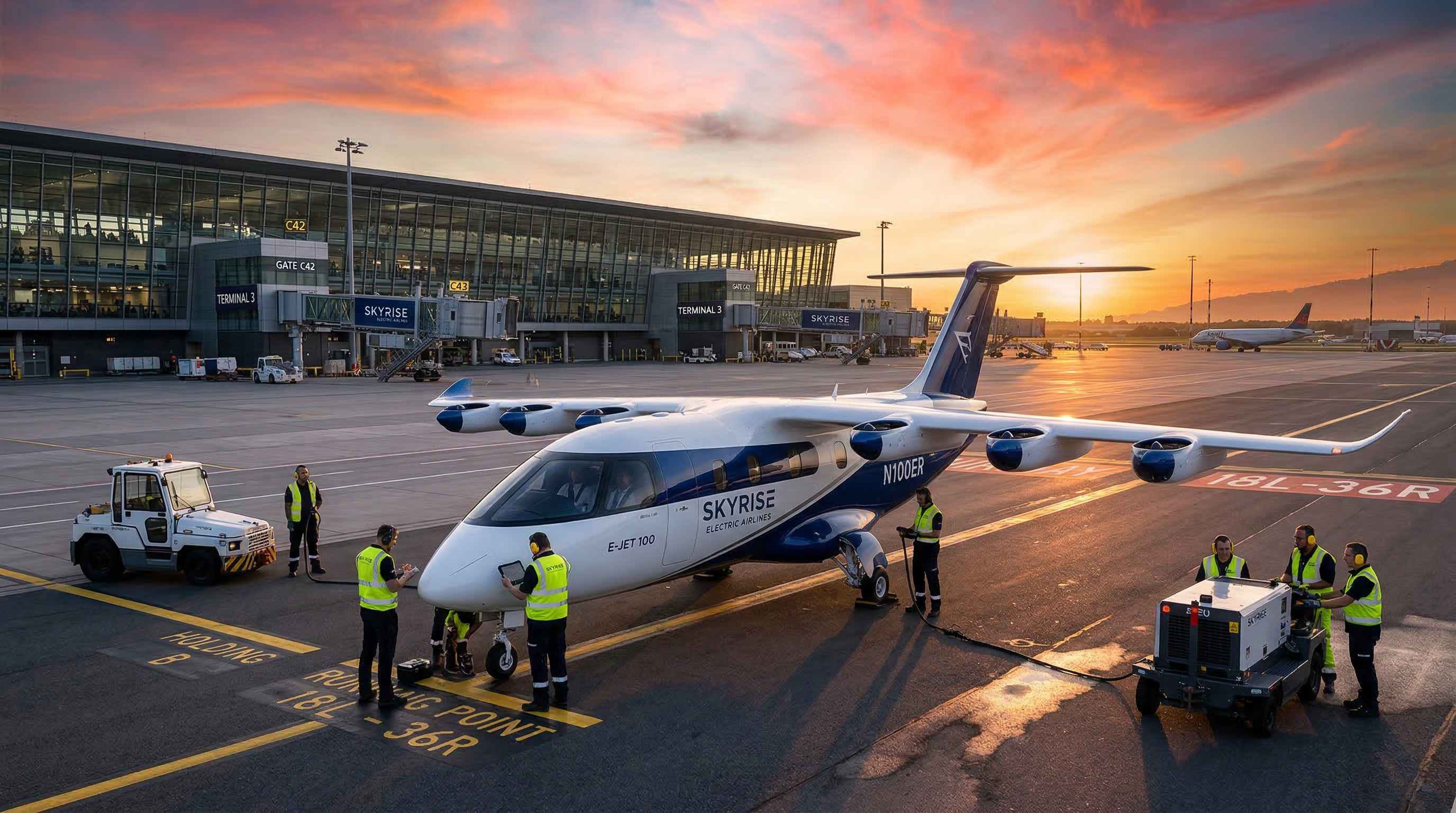
The idea of an electric airplane once belonged firmly in the realm of science fiction. Batteries were too heavy, motors too weak, and the energy requirements of flight too demanding. But a remarkable convergence of advances in battery technology, electric motor design, materials science, and aircraft engineering has brought electric aviation from fantasy to the verge of commercial reality.
In 2026, electric aircraft are no longer prototypes in research labs — they're flying, they're being certified, and in some cases, they're accepting passenger bookings. But the gap between proof-of-concept and widespread commercial aviation remains substantial. This is a story of genuine technological progress tempered by stubborn physical constraints.
eVTOL: The Air Taxi Revolution (Maybe)
Electric vertical takeoff and landing (eVTOL) aircraft have captured the imagination — and the investment — of the aviation industry. These are essentially electric helicopters redesigned from the ground up, often featuring multiple small rotors instead of one large rotor, enabling quieter operation, redundancy, and computer-controlled flight stability.
The promise is compelling: zero-emission urban air mobility. Imagine commuting from downtown Manhattan to JFK Airport in 10 minutes instead of an hour in traffic, at a fraction of the noise and emissions of a helicopter. Companies including Joby Aviation, Archer Aviation, Lilium, Wisk Aero, and EHang have collectively raised billions in funding pursuing this vision.
Joby Aviation: Leading the Pack
Joby Aviation, backed by Toyota, Uber, and Delta Air Lines, has emerged as one of the front-runners. Their five-seat piloted eVTOL can fly up to 100 miles on a single charge at speeds up to 200 mph, with a near-silent acoustic footprint compared to helicopters. The company completed over 1,500 test flights as of late 2025 and is working toward FAA certification, targeting commercial service launch by 2025-2026.
Joby has strategic partnerships with Delta Air Lines for airport integration and with Uber for ride-hailing infrastructure. The business model targets premium customers initially — think $3-5 per mile, comparable to current helicopter services but with the potential to drop toward ride-sharing costs at scale.
Archer Aviation: The Competitive Alternative
Archer Aviation, with backing from United Airlines and Stellantis, is developing the Midnight aircraft, a four-passenger eVTOL designed for back-to-back 20-mile trips with minimal charging time between flights. Archer claims their aircraft can complete a trip from Manhattan to Newark Airport in about 10 minutes.
The company has partnered with United Airlines to provide eVTOL service to United's hubs, with plans to launch commercial operations in cities including New York, Los Angeles, Miami, and Chicago. Archer received FAA certification for their first production facility in 2024 and is moving toward type certification.
The Reality Check
Despite the excitement, eVTOL faces significant hurdles:
- Certification complexity: Getting a new aircraft type certified by aviation authorities typically takes 5-10 years and costs hundreds of millions of dollars. The regulatory pathway for eVTOLs is still being defined.
- Infrastructure requirements: eVTOLs need vertiports — dedicated takeoff and landing facilities with charging infrastructure, noise management, and integration into urban airspace. Few cities have committed to building these at scale.
- Battery limitations: Current battery technology limits eVTOL range to 50-100 miles with reasonable payload. This works for urban air taxi routes but leaves little margin for weather diversions or holding patterns.
- Economics remain uncertain: The cost per mile needs to fall dramatically from helicopter-level pricing to attract mainstream passengers. Whether that's achievable at scale is unproven.
- Public acceptance: Convincing people to fly in pilotless or autonomous urban aircraft — even if technically safe — may take time.
Berg Insight, an aviation market research firm, projects that the eVTOL market will remain limited through the late 2020s, with meaningful commercial scale unlikely until the mid-2030s.
Regional Electric Aviation: The More Immediate Opportunity
While eVTOLs chase the urban air taxi dream, a quieter revolution is happening in regional aviation. Routes under 500 miles — think New York to Washington D.C., or Los Angeles to San Francisco — represent a significant portion of aviation emissions on a per-passenger basis, often flying half-full turboprops and regional jets.
This is where electric aviation could have nearer-term impact.
Heart Aerospace: Electric Regional Aircraft
Heart Aerospace, a Swedish startup, is developing the ES-30, a 30-seat electric-hybrid regional aircraft designed for routes up to 200 kilometers (about 125 miles) on pure battery power, or up to 400 kilometers with reserve hybrid generators for safety and flexibility.
The aircraft is designed to operate from existing regional airports with minimal infrastructure changes, targeting entry into service around 2028. United Airlines has placed a conditional order for 100 ES-30 aircraft, and Air Canada has committed to 30 units. The business case is compelling: operational costs could be 30-50% lower than conventional regional aircraft due to cheaper electricity versus jet fuel and reduced maintenance from simpler electric powertrains.
ZeroAvia: Hydrogen-Electric Propulsion
ZeroAvia is taking a different approach — hydrogen fuel cells instead of batteries. Hydrogen offers much higher energy density than batteries (though still far below jet fuel), making it better suited for longer regional routes.
ZeroAvia has successfully flown a 19-seat testbed aircraft on hydrogen-electric power and is developing powertrains for 40-80 seat aircraft targeting 500-mile range. The company has partnerships with Alaska Airlines, United Airlines, and American Airlines. The challenge is hydrogen infrastructure — airports need hydrogen production, storage, and fueling systems, which don't currently exist at scale.
The Battery Bottleneck: Why Long-Haul Electric Flight Isn't Coming Soon
The physics are unforgiving. Jet fuel contains roughly 12,000 watt-hours per kilogram. The best lithium-ion batteries today offer about 250-300 Wh/kg — a 40-to-1 energy density gap.
As a plane burns fuel, it gets lighter, improving efficiency over the course of a flight. Batteries don't. The weight penalty is constant, requiring structural reinforcement, which adds more weight, creating a vicious cycle.
For short flights where battery weight is a manageable fraction of total aircraft weight, electric propulsion is feasible. But for longer flights, current battery technology simply doesn't work. A trans-Atlantic electric airliner would need to be almost entirely battery, leaving little room for passengers or cargo.
The Path Forward: Better Batteries
Solid-state batteries — which replace liquid electrolytes with solid materials — promise energy densities of 400-500 Wh/kg, potentially reaching 700+ Wh/kg in future generations. Companies including QuantumScape, Toyota, and Samsung SDI are racing to commercialize solid-state technology for electric vehicles, and aviation will benefit from this progress.
Lithium-sulfur and lithium-metal batteries are also being researched for aviation applications, targeting 500-600 Wh/kg. But even at 600 Wh/kg — a level not expected until the 2030s — batteries would still have only 5% the energy density of jet fuel.
This is why hydrogen fuel cells, sustainable aviation fuels (SAFs), and hybrid-electric systems are being explored alongside pure battery-electric propulsion. Different solutions will likely serve different route lengths.
AI and Electric Aviation: The Hidden Multiplier
Artificial intelligence is playing a critical role in making electric aviation viable. AI-driven flight optimization can reduce energy consumption by 10-15% through optimized climb profiles, route selection, and regenerative braking during descent.
AI models predict wind patterns and weather with unprecedented accuracy, allowing electric aircraft to choose the most energy-efficient altitudes and routes in real-time. Battery management systems use machine learning to maximize battery life and performance, balancing charge cycles and thermal management to extend pack longevity.
For autonomous eVTOL operations, AI is essential for collision avoidance, airspace integration, and dynamic routing around obstacles and weather. The computational demands are significant, but the efficiency gains make electric flight more practical.
The Environmental Equation: How Clean Is Electric Flight?
Electric aircraft produce zero direct emissions, but the full environmental impact depends on how the electricity is generated. If an electric plane charges from a coal-heavy grid, the climate benefit is limited. If charged from renewable energy, the emissions savings are substantial.
Life-cycle analyses suggest that electric aviation powered by renewable electricity can reduce emissions by 60-90% compared to conventional jet fuel, accounting for battery production, electricity generation, and end-of-life disposal.
There's also the noise benefit. Electric motors are far quieter than jet engines or even piston engines, dramatically reducing noise pollution around airports — a major quality-of-life issue for communities near flight paths.
Investment and Industry Momentum
Despite the technical challenges, investment in electric aviation remains strong. According to PitchBook, electric aviation startups raised over $7 billion between 2020 and 2025. Traditional aerospace giants including Boeing, Airbus, Embraer, and Rolls-Royce are all investing in electric and hybrid-electric propulsion research.
Governments are supporting development as well. The European Union has set a goal for the first climate-neutral commercial aircraft by 2035. The U.S. Federal Aviation Administration is developing certification standards for electric aircraft. The UK announced the Aerospace Technology Institute's FlyZero program, targeting zero-emission flight technologies.
Startup Ecosystem
Beyond the major players like Joby and Archer, a diverse ecosystem of electric aviation startups is emerging:
- Eviation Aircraft (Israel/USA): Developing the Alice, a 9-passenger electric commuter aircraft for routes up to 440 nautical miles. Cape Air has ordered 75 aircraft.
- Bye Aerospace (USA): Focused on electric training aircraft, targeting flight schools where lower operating costs can quickly justify the technology.
- Lilium (Germany): Building a 7-passenger jet-powered eVTOL with projected 155-mile range, targeting regional air mobility rather than just urban hops.
- Vertical Aerospace (UK): Developing the VX4, a 4-passenger eVTOL with partnerships including American Airlines, Virgin Atlantic, and Japan Airlines.
- Beta Technologies (USA): Building electric aircraft for cargo and medical transport, with partnerships including UPS and United Therapeutics.
The diversity of approaches — from urban air taxis to regional cargo planes to training aircraft — suggests that electric aviation will enter the market through multiple pathways simultaneously, each targeting specific niches where the technology makes economic and operational sense.
The Realistic Timeline
So when will you actually fly electric? Here's the most likely timeline:
- 2025-2027: First commercial eVTOL services launch in select cities, targeting premium customers on very short routes (under 50 miles). Limited scale, high prices.
- 2028-2030: First electric regional aircraft (9-30 seats) enter service on routes under 200 miles. Primarily in Europe and North America.
- 2030-2035: eVTOL infrastructure expands, prices fall toward accessibility. Electric regional aircraft become common on short routes. Hydrogen-electric aircraft may enter service for medium regional routes (300-500 miles).
- 2035-2040: Hybrid-electric narrow-body aircraft for routes up to 1,000 miles may become available, using battery power for takeoff/landing (the most fuel-intensive phases) and sustainable aviation fuel or hydrogen for cruise.
- Beyond 2040: Long-haul electric flight remains unlikely without revolutionary battery breakthroughs. Sustainable aviation fuels and hydrogen will likely serve long-haul markets.
The Bottom Line
Electric aviation is real, it's coming, and it will transform short-haul and regional flight over the next 10-15 years. But it's not going to replace jet airliners for cross-country or international routes anytime soon.
The most productive way to think about electric aviation is as a solution for specific use cases — urban air mobility, regional hops, training aircraft, and cargo delivery — where the constraints of battery technology are manageable. For everything else, sustainable aviation fuels, hydrogen, and continued efficiency improvements in conventional aircraft will carry the load.
The transition won't be uniform. Training aircraft and short-range air taxis will electrify first, followed by regional passenger aircraft on routes under 300 miles. Medium-haul routes may eventually use hybrid-electric systems. But trans-oceanic and long-haul flights will likely rely on sustainable aviation fuels and hydrogen well into the 2040s and beyond.
What's certain is that aviation is entering a period of radical technological change. The jet age, which dominated commercial flight for 70 years, is giving way to a more diverse technological ecosystem. Electric propulsion, hydrogen fuel cells, sustainable fuels, and advanced aerodynamics will all play complementary roles in decarbonizing flight.
The age of electric flight is genuinely beginning. Just don't expect to fly electric from New York to London in this decade. But New York to Boston? That might happen sooner than you think.