The Circular Economy Is No Longer a Buzzword — It's Becoming a Business Model
For years, "circular economy" showed up in sustainability reports with limited real-world impact. It was aspirational language — reduce, reuse, recycle — without meaningful business transformation. But in 2026, circular strategies are becoming embedded in core business models, driven not just by environmental ideals but by hard economics, regulatory pressure, and genuine competitive advantage.
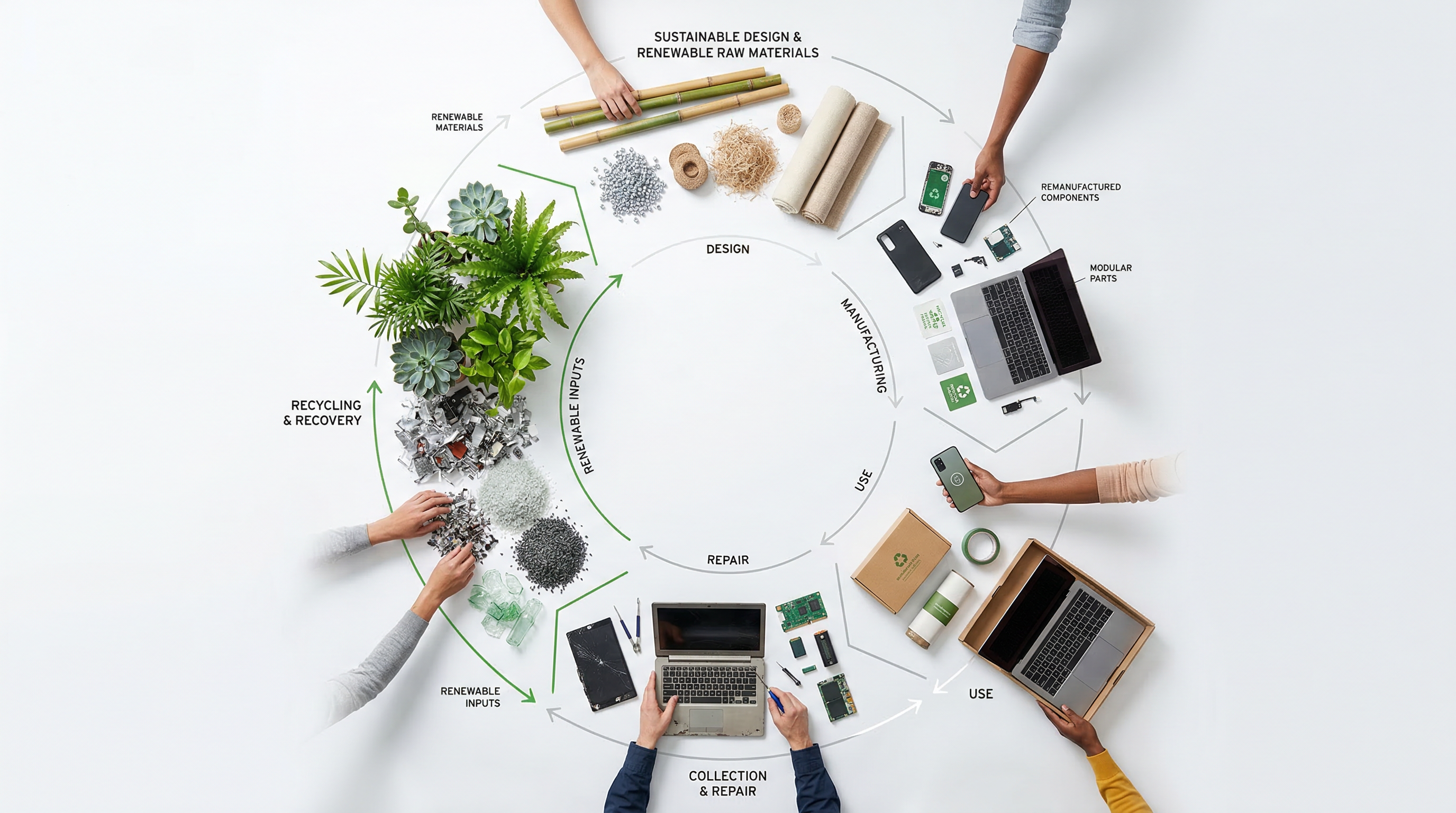
For years, "circular economy" showed up in sustainability reports with limited real-world impact. It was aspirational language — reduce, reuse, recycle — without meaningful business transformation. But in 2026, circular strategies are becoming embedded in core business models, driven not just by environmental ideals but by hard economics, regulatory pressure, and genuine competitive advantage.
The linear "take-make-waste" economy that powered industrialization for two centuries is giving way — slowly, unevenly, but unmistakably — to systems designed for circularity from the outset. This isn't charity. It's survival.
What Is the Circular Economy?
At its core, the circular economy is simple: eliminate waste by keeping materials in use as long as possible. Instead of extracting resources, manufacturing products, using them, and discarding them, circular systems design out waste, keep products and materials circulating, and regenerate natural systems.
The Ellen MacArthur Foundation, which has been instrumental in popularizing circular economy principles, identifies three core strategies:
- Design out waste and pollution: Products designed for durability, repair, remanufacturing, and eventual disassembly.
- Keep products and materials in use: Maintenance, repair, refurbishment, remanufacturing, and recycling extend product lifespans and material utility.
- Regenerate natural systems: Return biological materials safely to the environment and shift to renewable inputs.
The concept isn't new — indigenous cultures, pre-industrial societies, and necessity-driven practices have always emphasized resource conservation. What's new is embedding circularity systematically into modern industrial and digital economies at scale.
Construction and the Built Environment: Leading the Transformation
The construction industry is responsible for roughly 40% of global CO₂ emissions and generates enormous waste — over 600 million tonnes of construction and demolition waste annually in the U.S. alone. This makes it both a major problem and a major opportunity.
Designing Buildings for Disassembly
Traditional construction creates buildings that are difficult or impossible to deconstruct — materials are glued, welded, and permanently bonded. Design for Disassembly (DfD) flips this logic: buildings are designed so components can be easily removed, reused, or recycled at end-of-life.
Mechanical fasteners replace adhesives. Modular construction allows walls, floors, and structural elements to be unbolted and reused. Digital material passports — records detailing every component's composition, origin, and location — make future deconstruction efficient.
The Park 20|20 development in the Netherlands was designed entirely for circularity. Every component — from facade panels to flooring — can be disassembled and reused. Material passports catalog the building's materials in a digital database, treating the building as a "material bank" for future projects.
Low-Carbon Materials at Scale
Beyond design, materials themselves are evolving. Artificial intelligence is accelerating the discovery and optimization of these sustainable materials:
- Cross-laminated timber (CLT): Engineered wood products can replace steel and concrete in mid-rise construction, sequestering carbon rather than emitting it.
- Recycled steel: Steel is infinitely recyclable. Electric arc furnaces using scrap steel emit 75% less CO₂ than traditional blast furnaces.
- Low-carbon concrete: Cement alternatives using supplementary cementitious materials (fly ash, slag, calcined clay) or carbon-negative processes are entering the market.
- Recycled aggregates: Crushed concrete from demolished buildings can replace virgin gravel and sand in new concrete.
McKinsey research found that circular principles could abate 13% of embodied carbon emissions in construction by 2030 and nearly 75% by 2050 through material efficiency, reuse, and low-carbon alternatives.
Fashion: From Fast to Circular
The fashion industry produces over 100 billion garments annually, with most worn fewer than five times before disposal. Textile waste clogs landfills, and production consumes massive amounts of water, energy, and chemicals.
Circular fashion strategies include:
Take-Back and Resale Programs
Brands including Patagonia, Eileen Fisher, and H&M operate garment take-back programs, accepting used clothing for resale, repair, or recycling. ThredUp, Poshmark, and Vestiaire Collective operate digital resale platforms, creating secondary markets that extend garment lifespans.
Rental and Subscription Models
Rent the Runway pioneered clothing rental for high-end fashion. Nuuly (owned by Urban Outfitters) offers subscription-based clothing rental for everyday wear. These models shift ownership from consumers to platforms, incentivizing durability and maintenance.
Design for Recyclability
Most textiles are blends — cotton-polyester, wool-nylon — which are difficult to separate and recycle. Mono-material design — garments made from single fiber types — simplifies end-of-life recycling.
Chemical recycling technologies, pioneered by companies like Renewcell and Circ, can break down textile blends at the molecular level, recovering pure fibers for new fabric production.
Electronics: Closing the Loop on E-Waste
Electronic waste is the fastest-growing waste stream globally, exceeding 50 million tonnes annually. E-waste contains valuable materials — gold, silver, copper, rare earth elements — but recovery rates remain below 20%.
Modular Design for Repair
Fairphone, a Dutch smartphone company, designs phones with easily replaceable batteries, screens, and cameras. Users can swap broken parts without specialized tools, extending device lifespans from 2-3 years to 5+ years.
Framework, a laptop startup, takes modularity further — every component, from motherboard to display to keyboard, is user-replaceable and upgradeable. This challenges the planned obsolescence inherent in most consumer electronics.
Right to Repair Movement
Advocates have pushed for legislation requiring manufacturers to provide repair manuals, diagnostic tools, and spare parts to consumers and independent repair shops. The European Union's Right to Repair directive mandates repairability for electronics sold in EU markets, pressuring global manufacturers to adopt circular design principles.
Urban Mining for Critical Minerals
Old smartphones contain more gold per tonne than most gold ore. "Urban mining" — recovering valuable materials from e-waste — is becoming economically viable. Apple's Daisy robot can disassemble 200 iPhones per hour, recovering aluminum, copper, cobalt, and rare earth elements for reuse in new devices.
Food: Tackling Waste and Loss
Roughly one-third of food produced globally is wasted — about 1.3 billion tonnes annually. This represents not just wasted food but wasted water, land, energy, and labor, while generating 8-10% of global greenhouse gas emissions.
Surplus Food Redistribution
Too Good To Go, a Danish app, connects consumers with restaurants and retailers selling surplus food at reduced prices. The platform operates in 17 countries and has redirected over 100 million meals from landfills.
Imperfect Foods and Misfits Market purchase "ugly" produce rejected by grocery stores and deliver it to consumers at discounted prices, creating markets for food that would otherwise be wasted.
Composting and Anaerobic Digestion
Organic waste can be composted to produce nutrient-rich soil amendments, closing nutrient loops in agriculture. Anaerobic digestion processes organic waste to produce biogas (renewable energy) and digestate (fertilizer), capturing value from unavoidable food waste.
Upcycled Food Products
Companies like ReGrained turn spent grain from beer brewing into flour and snacks. Renewal Mill uses okara (soybean pulp from tofu production) to make baking flour. These "upcycled" products create new revenue streams from former waste.
Plastics: The Circular Economy's Toughest Challenge
Global plastic production exceeds 400 million tonnes annually, with less than 10% recycled. Most plastic is either landfilled, incinerated, or leaks into the environment, particularly oceans.
Mechanical vs. Chemical Recycling
Mechanical recycling — melting and reforming plastic — works for clean, sorted plastics like PET bottles but degrades material quality with each cycle and can't handle mixed or contaminated plastics.
Chemical recycling (also called advanced recycling) breaks plastic down to molecular building blocks, enabling infinite recycling loops. Technologies including pyrolysis, gasification, and depolymerization are being scaled by companies including Eastman Chemical, Loop Industries, and Agilyx.
However, chemical recycling is energy-intensive and expensive. Critics argue it's often "greenwashing" — providing cover for continued plastic production rather than genuinely closing loops.
Reuse Over Recycling
The most circular solution is eliminating single-use plastics entirely. Reusable packaging systems, pioneered by companies like Loop (Terracycle), deliver products in durable containers that are returned, cleaned, and refilled — the milkman model revived for the 21st century.
The Business Case: Why Circularity Makes Economic Sense
What's driving circular economy adoption isn't primarily regulation or environmental pressure — it's cost and resilience.
Volatile Commodity Prices
Virgin material prices fluctuate wildly. Copper, lithium, steel, and plastics have seen dramatic price swings. Companies using recycled or reused materials reduce exposure to commodity markets and price volatility.
Supply Chain Resilience
The pandemic, geopolitical tensions, and trade disruptions revealed fragility in global supply chains. Circular supply chains — sourcing materials from local recycling and remanufacturing — reduce dependence on distant, vulnerable sources.
Customer Demand
Consumers — particularly younger demographics — increasingly favor brands with credible sustainability commitments. Resale, rental, and repair services aren't just environmentally sound; they're revenue opportunities.
Regulatory Pressure
The EU's Circular Economy Action Plan includes requirements for recycled content, extended producer responsibility, and product passports. Companies operating globally must comply, creating market pull for circular business models.
The Digital Enablers: Data, AI, and Platforms
Circularity at scale requires information systems to track materials, match supply and demand, and optimize reverse logistics. Digital technologies are essential enablers.
Material Passports and Blockchain
Digital material passports record a product's composition, origin, and condition, simplifying reuse and recycling. Blockchain provides tamper-proof tracking for certified recycled content, combating fraud.
AI-Powered Sorting
Recycling facilities use computer vision and AI to identify and sort materials faster and more accurately than human workers. AMP Robotics deploys AI-powered robots that can sort 80 items per minute across multiple material types.
Sharing Platforms
Digital platforms facilitate sharing, rental, and resale. Peerby enables neighbors to share tools and equipment. Turo and Getaround enable peer-to-peer car sharing, increasing vehicle utilization rates.
The Challenges: Why Circularity Isn't Easy
Despite progress, significant barriers remain:
- Economics: Virgin materials are often cheaper than recycled alternatives due to subsidies, externalized environmental costs, and economies of scale.
- Infrastructure: Collection, sorting, and reprocessing facilities are underfunded and unevenly distributed.
- Design legacy: Billions of products already in use weren't designed for circularity — they'll need to work through the system.
- Consumer behavior: Convenience and low prices often trump sustainability. Changing habits requires incentives, not just awareness.
- Greenwashing: Companies can claim circularity while making marginal changes. Transparent metrics and standards are needed.
Policy and Market Failures
Current economic systems don't price environmental externalities. Landfill costs don't reflect long-term environmental damage. Virgin material extraction doesn't account for ecosystem destruction. This creates perverse incentives — linear models remain artificially cheap.
Effective policy interventions include:
- Extended Producer Responsibility (EPR): Manufacturers pay for end-of-life management, incentivizing design for recyclability.
- Landfill taxes: Higher disposal costs make reuse and recycling more attractive.
- Recycled content mandates: Requiring minimum percentages of recycled material in products creates guaranteed demand.
- Green public procurement: Government purchasing power can drive circular markets.
The EU's Circular Economy Action Plan, adopted in 2020 and strengthened through 2023-2024, provides a comprehensive policy blueprint. It includes sustainable product design requirements, right-to-repair legislation ensuring consumers can fix their devices, recycled content mandates requiring minimum percentages of recycled materials in new products, and explicit bans on planned obsolescence practices. These regulations are forcing global companies to adopt circular practices even outside Europe, as multinational corporations find it more efficient to implement circular designs globally rather than maintaining separate regional product lines.
The Bottom Line
The circular economy has moved from buzzword to balance sheet reality. Companies are adopting circular strategies not out of altruism but because linear systems are becoming economically and operationally unsustainable in an increasingly resource-constrained world.
Material costs are rising. Supply chains are fragile. Regulation is tightening. And customers increasingly reward circularity. These forces are more powerful than any sustainability report.
The transition won't happen overnight. Legacy infrastructure, entrenched business models, decades of optimizing for linear throughput, and deep economic inertia will slow progress. But the direction is unmistakably clear. The linear economy — extract, produce, discard — is ending. Not because it's immoral, but because it no longer works economically.
The circular economy is becoming the only economy that makes sense.